Imagine building your own humanoid robot without working for a major robotics company or spending a fortune on a commercial robot. You can print its body, assemble its mechanical components, program its movements, and experiment with artificial intelligence using tools developed for the open-source community. That is the exciting idea behind Zeroth Bot, an open-source humanoid robotics platform designed to make advanced robotics more accessible to makers, engineers, students, and developers. Instead of treating a robot as a finished product that you can only operate, this project encourages you to explore how the entire system works, from its physical structure to its control software. The official project describes Zeroth-01 as a 3D-printed humanoid platform built for simulation-to-real-world development and reinforcement learning.
What makes this project particularly interesting is the combination of affordable hardware, customizable mechanical design, and software for experimenting with robot control. You can use the project as a starting point for learning how actuators move joints, how sensors provide feedback, and how simulated robot behavior can be transferred to a physical machine. It also opens the door to exploring machine learning, motion planning, and AI-assisted robotics development. However, this is not simply a ready-to-use toy that requires no technical knowledge; building and programming a humanoid robot still involves careful assembly, configuration, testing, and troubleshooting. For anyone interested in learning robotics through hands-on experimentation, Zeroth Bot offers a compelling opportunity to move from watching robots online to understanding how they are built.
What Is Zeroth Bot?
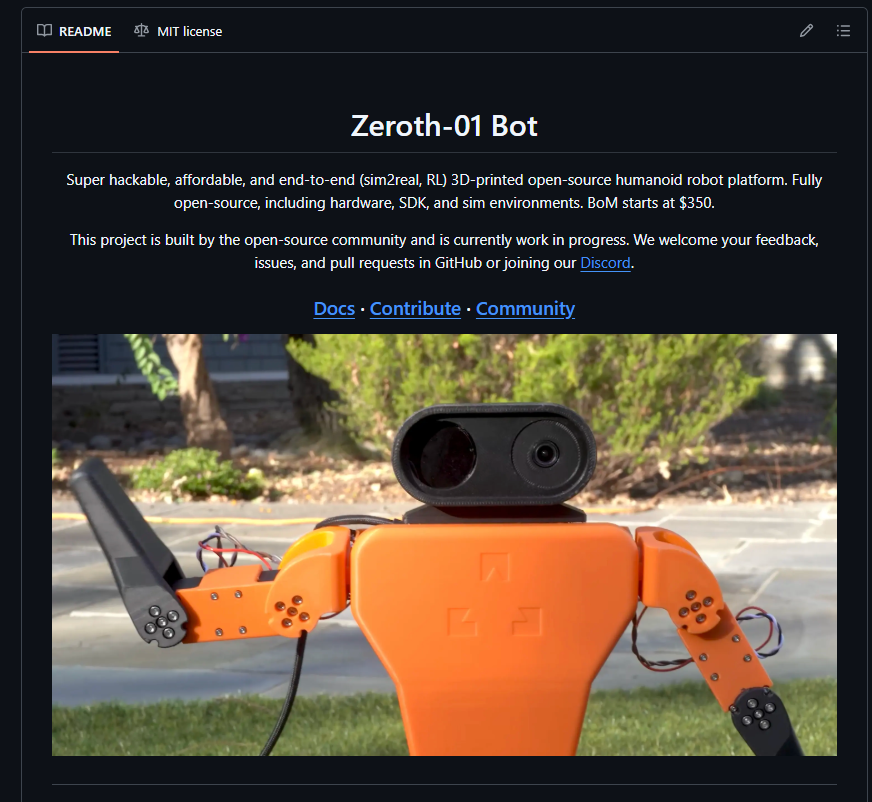
Zeroth Bot, also known as Zeroth-01, is a 3D-printed, open-source humanoid robot platform intended for developers who want to experiment with physical robotics and learning-based control. Its project repository brings together resources for the robot’s hardware, software development kit, and simulation environments, giving users a foundation for exploring different aspects of humanoid engineering. The official GitHub repository also describes support for basic locomotion, vision, and speech, while warning that the project has been under active development and may undergo breaking changes.
The most important difference between a platform like Zeroth Bot and a typical consumer robot is how much of the system is open to experimentation. You are not limited to a fixed set of factory-defined behaviors or a closed application. Instead, you can study the source code, examine the hardware documentation, learn how the robot communicates with its actuators, and investigate how its control system works. That makes it useful for people who want to understand robotics at a deeper level rather than simply operate a finished machine. If you are interested in the intersection of mechanical engineering, electronics, embedded programming, and artificial intelligence, this type of project provides a practical way to explore all four disciplines in one place.
The Idea Behind Open-Source Humanoid Robotics
Open-source robotics follows a straightforward principle: share designs, software, and technical knowledge so that more people can learn, build, improve, and contribute. Instead of every developer starting from an empty workspace, a community can build upon existing designs, document solutions, fix bugs, and develop new capabilities. In a humanoid robot project, that collaboration can cover everything from printable body components and actuator interfaces to simulation models and machine-learning experiments. The result is an environment where learning does not stop when the physical assembly is complete.
For example, a student might begin by studying a robot’s joint-control code, while an electronics enthusiast explores servo communication or sensor integration. A software developer could investigate motion-control algorithms, and a machine-learning researcher could experiment with reinforcement learning in a simulated environment. These contributors may approach the same robot from entirely different directions, yet their discoveries can help the wider community. Zeroth Bot follows this collaborative model through its public repository, where developers can explore the project and contribute through issues and pull requests.
Key Features of Zeroth Bot
Zeroth Bot combines a customizable physical robot with software intended for simulation, control, and AI-related experimentation. Rather than focusing on just one function, the project provides a foundation for exploring how mechanical construction and software intelligence work together. Its hardware and software components are particularly relevant to makers who want to learn by modifying real systems instead of following tutorials that end with a simple demonstration.
The major features include a 3D-printed humanoid structure, open-source development resources, Python-based control interfaces, and tools for training robot behaviors in simulation. The software ecosystem includes KOS-ZBot, which handles robot-level interfaces and hardware abstraction, and K-Sim Gym ZBot, which supports reinforcement-learning workflows.
3D-Printed Humanoid Body
One of the most appealing aspects of Zeroth Bot is its use of 3D-printed structural components. Instead of relying entirely on expensive, factory-manufactured mechanical parts, builders can produce many of the robot’s body components using a compatible 3D printer and the project’s design resources. This approach is especially attractive to makers who already work with CAD software, experiment with different materials, or maintain a home 3D-printing setup.
The real advantage goes beyond the convenience of printing a part. A printable design gives you a way to understand the mechanical decisions behind a robot, including joint placement, component mounting, structural support, and cable routing. If a bracket breaks or a design needs improvement, a maker may be able to modify the relevant model and manufacture a replacement rather than redesigning the entire robot. Nevertheless, printed components must be produced with suitable settings and materials, and they need to withstand the loads created by moving actuators. A successful build therefore requires more than attractive exterior panels; dimensional accuracy, strength, joint alignment, and mechanical clearance all matter.
Open-Source Hardware and Customization
The open-source approach gives developers room to investigate how the robot is constructed and controlled. Zeroth Bot’s repository includes access to the broader development ecosystem, with resources for its operating system, actuator interfaces, and simulation tools.
Customization can begin with relatively small changes, such as experimenting with software-controlled poses or adjusting a supported motion sequence. More advanced users may explore calibration, actuator behavior, sensor integration, or modifications to the simulation model. Hardware changes, however, need to respect the design’s electrical, mechanical, and software requirements. A different servo, for instance, may have different torque characteristics, communication requirements, dimensions, and power demands. Before modifying components, check the current documentation and confirm that the change is compatible with the robot’s control system.
How AI and Robotics Work Together
Artificial intelligence can help a robot move beyond executing a fixed sequence of commands. Traditional robot control often relies on carefully programmed instructions, while AI-based methods can learn patterns, interpret observations, and develop control strategies through training. Zeroth Bot is particularly interesting because its software ecosystem supports experimentation with reinforcement learning (RL) and simulation-to-real-world deployment. The official project identifies K-Sim Gym ZBot as the reinforcement-learning component for training whole-body control policies, including locomotion-related tasks.
Think of a simulated robot as a digital laboratory. Before testing a new walking strategy on the physical machine, a developer can train and evaluate a control policy in a virtual environment. The system can repeat experiments, observe the outcomes, and improve its behavior according to a defined reward function. Once a suitable policy has been developed, the next challenge is transferring it to the real robot, where friction, actuator limitations, mechanical tolerances, and sensor noise can produce different results. This is known as the sim-to-real problem, and solving it is an important part of modern robotics research.
Programming Your Own Robot Behaviors
Developers can use a humanoid platform to experiment with different kinds of robot behavior, depending on the capabilities of their hardware and software setup. A beginner might start by commanding a supported joint to move to a particular position, then create a sequence of poses for the robot’s arms or body. Someone with more experience could investigate coordinated movements, sensor feedback, and reinforcement-learning policies. The key is to build up gradually, testing each behavior before combining multiple actions into a more complicated sequence.
Python is especially useful for this kind of experimentation because it is widely used in robotics, machine learning, and scientific computing. Zeroth Bot’s KOS-ZBot software includes a Python API and tools for actuator management, calibration, and diagnostics.
How to Get Started with Zeroth Bot
If you want to build Zeroth Bot yourself, begin with the official documentation rather than ordering parts immediately. A humanoid robot contains several interconnected systems, and a missing bracket, incompatible actuator, or incorrect power arrangement can prevent an otherwise well-planned build from working. The project’s documentation provides an introduction, assembly information, and bill-of-materials resources that can help you understand the requirements before committing to a build.
Your first objective should be to understand the complete build process, including mechanical assembly, electronics, software setup, and calibration. Decide whether you want to construct the physical robot or begin with simulation to learn the software first. If you already have a 3D printer and programming experience, some parts of the process may feel familiar, but humanoid robotics introduces challenges that do not usually appear in simpler Arduino projects. Taking time to understand the design can save money and reduce troubleshooting later.
Explore the GitHub Repository
Start here: Zeroth Bot on GitHub.
The repository is the central place to explore the project’s source code, documentation references, and related software components. Read the main README first, then inspect the assembly documentation and bill of materials linked by the project. Pay attention to repository status, supported configurations, dependency requirements, and any changes that have occurred since the instructions were written. The public repository has described the project as a work in progress, so it is important to verify that the instructions you follow match the current version.
If you want to contribute code, browse the existing issues and pull requests before making changes. For a first contribution, consider improving documentation, reproducing a software issue, or testing a clearly defined feature. Keep track of the version you use so that you can explain your results accurately when asking for help. Open-source development becomes much easier when you can share your configuration, error messages, and the steps needed to reproduce a problem.
Review Hardware and Assembly Requirements
Before purchasing components, review the official bill of materials and identify the parts required for the exact configuration you intend to build. These may include 3D-printed structural components, compatible servo actuators, a controller or onboard computer, cables, fasteners, sensors, and a suitable power system. The precise requirements depend on the documented build, so do not assume that generic hobby servos or an arbitrary single-board computer will work as direct replacements.
The project’s GitHub description has advertised a bill-of-materials starting point of US$350, but that figure should be treated as a reference rather than a guaranteed final cost.
Configure Software and Test the Robot
Once the hardware is assembled, resist the temptation to run a complicated AI demonstration immediately. Start by installing the software versions specified in the documentation and confirming that the controller can communicate with the robot. Then follow the documented calibration procedure, check individual actuator responses, and verify the permitted movement range of each joint before attempting coordinated motion.
The KOS-ZBot software provides hardware interfaces and command-line tools for functions such as actuator control, calibration, and diagnostics. Its documentation also describes configuring a robot-specific service so that the corresponding actuator settings and movement limits can be applied.
Skills You Can Learn by Building a Humanoid Robot
A project like Zeroth Bot can connect several engineering disciplines in one practical experience. Mechanical design becomes easier to understand when you can see how a joint moves under load, while electronics becomes more meaningful when you troubleshoot a real actuator or power problem. Software development also becomes more tangible because a change in code can affect the physical behavior of a machine. Rather than learning each subject in isolation, you can see how mechanical, electrical, and computational systems depend on one another.
Here are some of the skills you can develop through a structured build:
- 3D printing and mechanical design: Learn about component orientation, tolerances, material strength, and mechanical assembly.
- Electronics and actuator control: Explore servo communication, power distribution, wiring, and movement limits.
- Python programming: Develop scripts, work with software interfaces, and automate repeatable tests.
- Simulation and reinforcement learning: Study virtual robot models, reward functions, training workflows, and policy evaluation.
- Debugging and system integration: Diagnose faults that emerge when individual components are combined into a complete robot.
These skills can also be useful beyond humanoid robotics. The same knowledge applies to robotic arms, autonomous vehicles, industrial automation, research platforms, and educational robotics. For students, the project could provide material for a portfolio or engineering demonstration. For experienced developers, it can become a starting point for exploring more advanced control systems. The most valuable outcome is not simply owning a robot; it is understanding the engineering decisions that make it work.
Zeroth Bot for Students, Makers, and Developers
For students, Zeroth Bot offers a way to connect theoretical concepts with a physical system. Topics such as kinematics, feedback control, motor behavior, and machine learning can feel abstract when presented only through equations or slides. A humanoid robot provides a concrete example of how these concepts interact. Students can start with simple observations and progressively investigate more complex behaviors as their understanding improves.
Makers can approach the platform as a customization project. If you already enjoy designing printed parts, building electronics, or creating small robots, a humanoid platform can challenge you to integrate those interests into a more sophisticated system. You might focus on mechanical reliability, sensor experiments, software improvements, or simulation. The open-source approach also allows you to study how other developers solve problems instead of having to discover every solution independently.
Developers and researchers may be more interested in the software architecture and learning-based control tools. They can investigate how a control policy is trained, how actuator data is represented, and what changes are needed when a simulated model behaves differently from the real robot. The official repository and related K-Sim resources provide a starting point for exploring these workflows.
Advantages and Challenges of DIY Humanoid Robotics
The biggest advantage of an open-source humanoid robot is the opportunity to learn by doing. You can inspect the design, explore the software, understand how the hardware operates, and adapt your approach as your skills improve. The project can also be more approachable than designing a complete humanoid robot from scratch because it provides an existing platform and related development resources. For hobbyists and educational teams, this can turn an ambitious idea into a series of smaller engineering tasks.
There are challenges, though, and it is important to understand them before starting. Humanoid robots have many moving parts, which makes mechanical alignment, actuator calibration, and power management especially important. Reinforcement learning may require substantial computing resources and repeated experiments, while moving a successful policy from simulation to physical hardware can involve considerable tuning. Documentation and software interfaces may also change during active development, meaning that a tutorial written for an older version may not work as expected.
| Aspect | Potential advantage | Challenge to consider |
|---|---|---|
| 3D printing | Customizable parts and easier replacement of some components | Print quality, material strength, and dimensional accuracy |
| Open-source software | Access to code and development resources | Requires setup, debugging, and version management |
| AI and reinforcement learning | Opportunities to investigate learning-based control | Training can take time and require suitable computing hardware |
| Hardware integration | Hands-on electronics and mechanical experience | Power, wiring, calibration, and compatibility must be managed carefully |
| Cost | A published starting bill of materials | Actual spending varies with shipping, tools, components, and configuration |
The best approach is to treat the project as an engineering learning journey rather than expecting an instant, perfectly functioning humanoid. Begin with a clear goal, such as getting the actuators working reliably or reproducing a documented movement. Once that works, move on to more advanced experiments. Small, repeatable successes make it easier to identify faults and build confidence without risking unnecessary hardware damage.
How Open-Source Robotics Is Shaping the Future
Open-source robotics gives students, independent makers, and small research teams opportunities to explore systems that would otherwise require substantial development effort. When mechanical designs, software interfaces, and simulation tools are shared, developers can spend more time investigating new ideas instead of rebuilding every underlying component. A shared platform also creates opportunities for collaboration: one person can improve a controller, another can document a hardware modification, and someone else can investigate a training method.
Zeroth Bot illustrates this approach by bringing together 3D-printed hardware, robot-control software, and reinforcement-learning resources.
For the next generation of engineers, this matters because innovation often starts with experimentation. A student who begins by printing a robot part might eventually learn CAD design, electronics, control theory, or machine learning. Someone who starts with a Python script could progress toward training a controller or contributing to a larger robotics project. Open-source communities help connect these learning stages by making existing work available for inspection and improvement. The result is a more collaborative path into robotics, where people can contribute at different levels of experience.
Conclusion
Zeroth Bot is an exciting project for anyone who wants to explore the engineering behind humanoid robots. Its combination of 3D-printed construction, open-source software, and support for simulation and reinforcement-learning experiments makes it a useful platform for hands-on learning. Whether you are a student, electronics enthusiast, 3D-printing maker, or software developer, it offers a starting point for exploring the relationship between physical machines and intelligent control systems.
The best way to approach the project is to begin with the official documentation, understand the hardware requirements, and build confidence through small, carefully tested experiments. Do not worry about mastering every aspect of robotics on day one. Learn how the mechanical structure works, test the actuators, understand the control software, and explore simulation before attempting advanced behaviors.
Ready to explore the project?
Visit the official GitHub repository: https://github.com/zeroth-robotics/zeroth-bot
Study the design, check the build requirements, and start exploring how open-source robotics can turn your curiosity into practical engineering skills. The next robot you admire does not have to remain something you only watch on a screen. With the right resources, patience, and experimentation, it can become a project you learn to build and improve yourself.
Frequently Asked Questions
1. What is Zeroth Bot?
Zeroth Bot, also known as Zeroth-01, is a 3D-printed, open-source humanoid robot platform designed for experimentation with robot control, simulation, and reinforcement learning. Its repository provides access to development resources and related software components.
2. Is Zeroth Bot suitable for beginners?
It can be a useful learning project for motivated beginners, especially those interested in 3D printing, Python, electronics, and robotics. However, assembling and programming a humanoid robot requires technical effort. Beginners should read the documentation, understand the component requirements, and start with basic software or simulation experiments before attempting complex movements.
3. How much does it cost to build Zeroth Bot?
The official GitHub description has listed a bill of materials starting at US$350. This is a starting reference, not a guaranteed final price. Your actual cost will depend on the hardware configuration, printing materials, tools, shipping, taxes, and any replacement components required.
4. Can I program Zeroth Bot using Python and experiment with AI?
Yes, the project’s software ecosystem includes a Python API for robot control and resources for reinforcement-learning experiments. You can explore supported actuator controls and simulation workflows, then investigate more advanced behaviors as you become familiar with the system. The precise capabilities depend on the software version and hardware configuration.
5. Where can I download the Zeroth Bot project files and build instructions?
Start with the official Zeroth Bot GitHub repository. From there, follow the links to the project’s documentation, assembly guide, and bill of materials. Review the current instructions before purchasing components because software and hardware requirements may change as the project develops.